
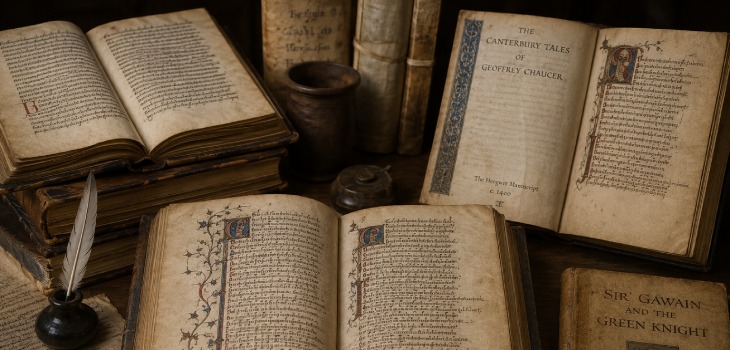
With each new presentation of a poem, the scribal process ran the possibility of change. There were occasions when change was the inadvertent result of the operation: one instance of this is the phenomenon of what scriptologists now term "eye-hap" in which, fudging between two like endings, the copyist's eye moves: when the eye jumps, whole lines disappear. When eye-skip brings text to an inglorious conclusion, words become divided, one or two of which might be lost, or a scribe uncertain if he sees one or two words can completely transform meaning.
But all other changes were premeditated. For instance, an attempt to "modernize" archaic spellings, replace words with regionally other modern forms. This swapping out of forms went on across over fifty manuscripts of Piers Plowman by Langland perdu. In addition, there is not a single uniform and consistent record of the poem to be found, which has made it possible for scholars to argue that three versions of the poem should now be recognized. Whether these different versions of the poem are manifestations of Langland's subsequent revisions or are derived from scribal meddling is still an open question.
The works of Chaucer exhibit such slippery instability. The Canterbury Tales survives in almost everything near eighty manuscripts, each of which has been affected by some small distortion in ideality, in metre, in harmony, in wordage. Because one cannot trust any single copy as being original, the text critic lays one line of evidence over another until the plausible text of an author is reached.
Survival in the medieval archive was never guaranteed. A significant number of Middle English poems exist in a single manuscript copy only – meaning one fire, one flood, one careless owner could have erased them entirely. The Pearl-poet's works survive exclusively in Cotton Nero A.x, a modest fourteenth-century manuscript that passed through multiple hands before Robert Cotton acquired it in the early seventeenth century. Had it not entered his library, Sir Gawain and the Green Knight might be unknown today.
Other texts fared better through sheer multiplication. The Auchinleck Manuscript, compiled around 1330s Edinburgh, preserves over forty romances and reflects something close to a commercial book trade. Chaucer's Canterbury Tales survives in more than eighty witnesses, with the Hengwrt and Ellesmere manuscripts representing sharply different editorial choices by their scribes.
Each surviving manuscript carries marks of its own history – ownership inscriptions, water stains, rebound gatherings, trimmed margins. Preservation was selective, shaped by prestige, accident, and institutional chance rather than literary merit.
Not as static systems of control over authorial texts, these volumes were very much like relics awaiting a multitude of burnishing hands. Scribes would help exercise poems from the overwhelm of dialectal smoothing, garble them in misreading, silently correct their errors for the purpose of otherness.
Such variants aren't mainly contributing blemishes on page. They tell you more about the span of language, reading communities, and literature as the poems moved down the manuscript transmission across centuries. In its very tradition, the fixed was always tied up with the fluid. This essence of copying would instill movement and life into texts on which every Middle English manuscript combined the poem and the hands of the labor keeping it alive.

We are starting the day with some good news, Oxford University has come top in the annual QS Rankings in eight subject areas, including English and Archaeology - which triumphs for the fourth year in a row:https://t.co/nj14zmbFo7 pic.twitter.com/wLy5ZFFnKm
— University of Oxford (@UniofOxford) March 4, 2020